Wednesday, August 10, 2011

First Primitivist Church of the Planet Earth: Part One


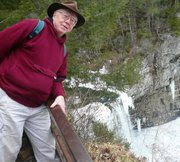
Photos of Arvid Shulenberger (1919-1964) from his WW II days. Photos published with permission of his son, Dr. Eric Shulenberger.


In this and the next installment in the Mad Hermit series, the Mad Hermit remembers some fundamental doctrines (teachings) of the First Primitivist Church of the Planet Earth. The heresies of this church are one, which is called Forgetting. Apostasy from the First Primitivist Church is called Postmodernism, which is also a new kind of forgetting. Followers of certain sects of Protestantism, or modernist Catholicism, both of which are known in the desert as Protestantism Enlightened or Gnosticism Lite, as well as all sorts of people who no longer have any idea what they are, are sure to be offended by the Mad Hermit.


The Second in a Series of Mad Hermit Visions


The Mad Hermit can elude much of the world, but he cannot escape memory. He is seeking God in contemplation, but he has lived a life, and he knows he must allow times when he goes back into the memories and wonders what to think now. Here on Masirah Island he climbs on the sperm whale’s skeletal head and stares at the ocean to the south. There are over 8000 miles of uninterrupted ocean between the whalebone head and the icy wall of Antarctica. That is why the Anglo-Saxon poets called it the “hwalrade,” the whale road. It is a kind of blankness, like the blankness of Melville’s white whale, which is what the contemplator needs, but today he has a reckoning with what humans can do in the face of that blankness. The answer, he realizes, is one of the fundamental principles of what he laughingly calls, with some redundancy, the First Primitivist Church of the Planet Earth. In this installment and the next, we will listen to his musings. So let us hear from the Mad Hermit as he suns his aches on the whale’s warm bones:


I dozed and woke stretched out on this massive blank cranium. I dreamed that I was in a long and annoying (they all were) discussion in graduate school in English, fifty years ago. The argument among the faculty (the gods who controlled our academic destinies) was over what the Ph.D. program I was in should be called. A Ph.D. in Rhetoric was what the department was leaning toward; another was a Ph.D. in Hermeneutical Phenomenologies. Other names were proposed. A mere graduate student, I suggested a Ph.D. in Poetics, which drew silence. In the ensuing nightmare discussion one professor said (for what reason I cannot recall) that a Muslim once told him that going to the mosque is “a blaze of glory in a dying light.” In my dream a light went on in my own mind and I awoke to the sound of waves and said “that’s what great art is!” I remember, in my exultation of insight, leaning over to taking a cigarette from a scurrying crab . . . and then I awoke before inhaling. But the teacher’s words, slow and deliberate, came back in a blaze of glory:

Art?

Art is making, or if good art is meant, right making. The word poetry derives from the Greek for to make. Law, medicine, bricklaying, teaching are arts. Art (a making) is distinct from science (a knowing), although it presupposes science in the maker (artist).

He was a tall and lanky ex-Air Force radar officer named Arvid Shulenberger, and when he stretched out his long arms, he reminded me of Frost’s image from “A Mending Wall” of an old farmer carrying a small boulder “like an old stone savage armed,” for he was earthy and elemental in his thinking as in his presence. I was terrified of him, for I knew he knew something about life and learning. In the whirl and blur of graduate school nonsense with this prof saying this and that prof saying that, suddenly there was a blaze of glory in the dying light. Shulenberger was a writer who had sought answers to perennial questions, answers he always referred to as the philosophia perennis, a phrase attributable to Leibnitz but also found in substance in St. Augustine and Al Farabi. It was popularized by Aldous Huxley in his book of the same name.

In class after class, Shulenberger talked on as some of us wrote down and drank in every word, which we discussed afterwards over home brewed beer, a particular West Texas version calculated to inspire robust discussion and headaches that would crack granite. Gradually, Shulenberger unfolded all the principles of the Orthodox Poetic, a chief virtue of which was, he said, that not one word or idea in it was original. It was the truth of the ages, carved in stone. Over the semester this seminar in literary criticism aroused anger and prompted notoriety among graduate students and graduate faculty, a few of whom began to slip into the room and take notes for themselves.

We asked questions and we listened. It was as though the man had been to the mountain top and come down with the answers. Something was going on that did not go on in other literature seminars, in which no one ever said anything they considered true or real. It is called teaching. As we sat as his students, we began to learn just how Shulenberger came by this wisdom. Fond of saying that the primary purpose of criticism was pointing, he pointed us to the sources he had used to distil these questions and answers, which he had then put into a slim mimeographed document in the form of brief, concise questions and answers: The Orthodox Poetic: A Literary Catechism. The, not a. As we learned, the sloppy seas of relativism receded and we stood on what we knew was hard, firm rock. I now say a prayer of gratitude for him and his teaching, which then informed my teaching for the next fifty years.

I sigh again, remembering the joy of those days, the joy of reaching an island while exhausted by intellectual storms. Then I sigh yet once more, tears coming to my eyes, for all the failures of my own teaching, of always feeling on the edge of communicating some of the great traditional answers to the great perennial questions and never quite getting there. “You must form your whole person into a question before you can begin to find or understand the answer. You must live in questions,” I would say time and time again. Looking back now, I see that I and Shulenberger and a handful of others were isolatoes in the crowd of post-modernists, who were just then coming into existence—though their next of kin had walked the streets of Athens, Rome, Alexandria, London—

What is the city over the mountains
Cracks and reforms and bursts in the violet air
Falling towers
Jerusalem Athens Alexandria
Vienna London
Unreal


The Old Possum—T.S.Eliot—had it pretty well figured, I guess: the towers of the West were collapsing. The time had arrived when all belief has disappeared and when the primal things have been forgotten in the ruined cities. The makers of poems now saw only their own reflections in mirrors of despair, now machines threw pots only for money, now the last cathedrals were crumbling into dust or, worse, into museums and salons des refuses, another variety of consumer junk for ego bolstering.

Ananda K. Coomaraswamy, Shulenberger told us, was Curator of the Boston Museum of Fine Art and yet he believed that museums were unnatural frauds and should be abolished. In Christian and Oriental Philosophy of Art and The Transformation of Nature in Art, this great Orientalist argued cogently for the medieval view of art—Christian and Oriental—that art is making for a purpose, and that purpose is truth through beauty—beautiful and useful poems, cathedrals, pots, swords, dresses—for our lives. Otherwise he said, art is merely superstition, even an idolatry. I think of the railways trains full of paintings hoarded by the Nazis in their belief in “kultur.” I think of a thousand inane conversations overheard in art galleries and bookstores: “but is it art, my dear? How do you know?”

Shulenberger, with his grasp of Aristotle, Coomaraswamy, St. Thomas Aquinas, Jacques Maritain, Dr. Samuel Johnson, and the nature of writing itself, blew the academic fogs away. Now, sitting on this desert beach and staring south, I remember what a delight came from the simple statement, art is making, and the consequent understanding that when we spoke of art, we were not talking about the estoterica of museums, salons, and classrooms, or the romantic delusion that art is creation, but of a fundamental human activity Aristotle and other Greeks had defined in the principle, art imitates nature. More, as Shulenberger explained, art as a process of making imitates nature in the process of becoming. A man making a pot ten thousand years ago and a poet in Greenwich Village making a poem last night and a computer brain crafting a new program in Iceland and a gunsmith in Kentucky making a long rifle are all engaged in one fundamental human activity: art imitating nature, which is the foundation of culture. Homo faber we are, art is what we do.

Further, there is no division between the “fine arts” and the “servile arts,” an artificial division fostered by some of the romantics. Works of art have a purpose: a poem should be able to hold water or hit a target. All great art is religious and its purpose is to glorify God or the gods or at least to depict the world in reality and truth. One of Shulenberger’s favorite words was “phony.” “Faulkner is a phony academician” (gasp). His other zingers—like “Northrop Frye[a new critic much admired then] is a poop”-- which he fired in between explaining the doctrines struck the devotees of the academe like thunderbolts. And pissed them off royally. But they inspired thought and discussion that brought fresh air into the university.

I sit here laughing just to think about the uproars he caused. One of his students proposed to write a Master’s Thesis on “the truth of Hemingway’s fiction.” “The truth?” one committee member sputtered. “All his fiction?” another sneered. And, finally, “you, a Master’s degree student, are going to do all this?” The doughty student: “Sir, I thought that was what we were here to do.”

No, no, no, the precious (another Shulenberger curse word, like “queer,” “academic,” and “sophisticated”) committee maintained that the purpose of the study of literature was to analyze, analyze, analyze, never to judge or reach conclusions. Shulenberger taught that the purpose of education was precisely to learn to judge things, even if we made mistakes. Education, like art, had an end, and that end had something to do with becoming fully human in the classical sense.

In his classes, we learned that we were sitting in a vast colloquium with the greats—Plato, Aristotle, Dante, Socrates, Johnson, Cervantes—and that we had a right to be there and participate in the great dialogue.

Ah, the winds blow in off the Indian Ocean. An older dhow rounds the tip of the island and chugs north on its ancient diesel. The night is coming on, in more ways than one. Even Masirah is now being sucked up into the world of phoniness. Back to prayer, before they find I don’t have a current passport or visa and ship me back to the country where mind has lost its moorings.


Some time ago The Mad Hermit made a list of the works any aspiring student of literature or the arts in general should know. The first, of course, is Shulenberger’s:

http://www.cs.utsa.edu/~wagner/creative_writing/shulenberger.pdf

If that link does not work for you, try the link here: http://failedhermit.blogspot.com/2010_03_27_archive.html

Coomaraswamy, Ananda K. Christian and Oriental Philosophy of Art. New Delhi, 1994 (reissue).
Coomaraswamy, Ananda K. The Transformation of Nature in Art. New Delhi, 1995 (reissue).
Maritain, Jacques. Art and Scholasticism. New York, 1934.
Maritain, Jacques. Art and Poetry. London, 1945.
Johnson, Samuel Dr. Preface to Shakespeare (1765) and Lives of the English Poets (1781).
Bate, Walter Jackson. The Achievement of Samuel Johnson. New York, 1961.
Aristotle, Poetics (330 BC).
Plato, The Republic and other dialogues (c380 BC).

Note: Arvid Shulenberger also wrote a novel, Roads From the Fort; a study of James Fenimore Cooper’s fiction; several volumes of poems; and this delightful piece: http://flightjournal.com/ME2/dirmod.asp?sid=&nm=The+Magazine&type=PubPagi&mod=Publications%3A%3AArticle+Title&mid=13B2F0D0AFA04476A2ACC02ED28A405F&tier=4&id=A0ACE92D17FF40D7ABE80D04D77FDA7B

His son, Dr. Eric Shulenberger, has written a major account of his father’s WW II flight squadron: http://www.amazon.com/Deny-Them-Night-Sky-Squadron/dp/sitb-next/0976735504

Thursday, July 28, 2011

Eruptions of the Mad Hermit: Tweeting on Masirah


The above is a photo of the only public cross in the entire Arabian desert. It is located at the northern end of Masirah Island.


A time is coming when men will go mad, and when they see someone who is not mad, they will attack him saying, ‘You are mad, you are not like us.' –St. Anthony of the Desert

[Raskolnikov] dreamed that the whole world was condemned to a terrible new strange plague that had come to Europe from the depths of Asia. In this dream, each thought that he alone had the truth, and each was at war with all the others, slaughtering them in a rage of destruction. -Dostoevsky, Crime and Punishment


There are stories of truly mad hermits, even amongst the holiest of the Desert Fathers, though as the Russian peasants know, it’s not always easy to tell the difference between the holy and the mad. As Chesterton pointed out, by any worldly standard, Christ was mad. One might say, a homeless mad vagrant. But, of course, according to Christians Nouveaux, the whole enterprise of the Desert Fathers was mad and best left behind. These disgruntled chaps should have joined a Peace and Justice Group or posted little notes on the parish bulletin board.

Nevertheless, the movement of thousands of people to the deserts of Egypt and Israel was one of the most important convulsions in Christian history. From the third century A.D. until as late as the seventh, a great reaction took place against a worldly Christianity that had lost its bearings in the post-Constantinian relaxation. It gave birth to Christian monasticism, another species of madness the modern Christian fears and despises.

But where did you think Jesus, Elijah, and John the Baptist slept and dreamed? In the Jerusalem Hilton?

There is a Mad Hermit who dwells in the desert zones of this blog. Which kind of madness does he have? Which kind do you have? You be the judge.


The Mad Hermit awoke in the usual desert dawn of Oman, the hottest nation in the world, when the sun finds billions of tiny mirrors to magnify its rage against water. Ah, he thought, the light that burns out the madness of the world. He had come here as a teacher in 1994, seeking a refuge from modernism. And from all
–isms and –ologies of the cities of the world.

Late in 2002, his last two-year contract had expired and there was no promise of another. The University has expelled him from his campus home, and escorted him to the airport for his official exit. He had left the plane at Dubai and re-entered the country by land, slipping past the border guards on an old track he had used for camping. He recovered his aging Land Rover, already loaded with his camping gear, from a friendly Pakistani mechanic, and with sunburned face and a worn kumma on his head, stealthily moved about the country, easily mistaken for an ex-pat oil worker.

In the grim Omani summer he knew no better refuge than one of the thousands of coves on the Arabian Sea, in one of which he pitched his tent and dangled his feet in the waters of the Gulf. [In my original manuscript there follow a great number of other details people who read nowadays, pass over. “Too much information!”] Thinking of his classroom days, the mad hermit remembered this desperate cry of the modern, and watched sardines nibble at his toes.

The world looked different from Oman when he first arrived. It was still one of the least known and frequented countries of the world. He began to enjoy camping in the desert weekend after weekend, where the only sound was silence. And by chance, he began to read books about the Desert Fathers.

At any rate, if the reader is still with me (a 10-90 shot), after two months of Arabian Gulf summer, the hermit had nearly baked out of his head the millions of strands of argument and association that frustrate any attempt at contemplation. The great Cloud of Unknowing was just beginning to form when, drat it, the Mad Hermit discovered that his last tin was gone and his last bottle of water emptied.

At the old suk in Muttrah, he looked about for the least modern shopping center he could find. But as he eased into a ramshackle grocery, past the sign reading “Moslems not Permitted in the Pork Room,” he spotted a sight he had first encountered in 1988. In the center of a spacious area surrounded by shops, there were Arabs in disdashas sipping their espressos and talking on cell phones. They were all facing each other but talking with someone not present. “Checking up on their wives, like as not,” an Aussie muttered.

Then, in the twinkling of a camel’s eye, the world had changed for Arabia Deserta. In the same year a nation that had as yet only three paved highways, had entered cyberspace, via fiber optic cables and cell phones manufactured in Finland. The immemorial desert scene of men gathered around an evening charcoal fire and roasting their goat kebabs was still common after the last Allah Akkbar!prayer call, but the desert night now rang with the sound of cell phones across the dunes and salt wastes.

Gradually, the mad hermit discovered stratagems for living in desert places, in the mountains and on the coast. From time to time he was forced to use visit suks and villages to replenish his stores. Like Father Foucault, he found that it was possible to live on little else but palm dates, which Oman supplied in abundance twice a year. Once a week he slipped into a Catholic church for prayer and the sacraments. He particularly enjoyed Mass (and the sermons) in Marathi, Konkani, Malayalam, Arabic, Tagalog, Sinhala, or Tamil, so that he did not have to listen to the cretin English of the modern church. When he was within reach of a mosque, he knelt on a mat and prayed the Angelus at prayer calls.

Torn by a lust he could not conquer, his visits to the shopping centers continued every few months, and by 2004 he had found himself loitering around a an internet café, where dozens of young men were clattering on the keys and giggling at porn sites. What madness! he thought. As far as he could tell, the planet had been consumed by a huge beast named the Internet. Back in the desert, he prayed to be freed of the demon of curiositas.

By 2010 he had turned seventy years of age, and was as thin as a young date palm. The Land Rover, held together by the wiles of the Pakistani mechanic, now chuffed along like an aging camel, and he himself had become a legend, especially among the Bedouin bands that moved about in Toyota pickup trucks. He thumbed his prayer books, hurled rocks at black scorpions and camel spiders, and fought the demons that pulled him away from God. He prayed that there would be another hermit whom he might meet once a week, as the Desert Fathers did. None came.

A garrulous Filipino priest counseled him in confession to join the parish charismatic community, but he ran from the church and ploughed back into the dunes, screaming “no!” until his throat was too dry to scream any more.

It was time to retreat farther, and he remembered his visit to Masirah Island in 1990. The ferry carried him and the Rover to the ninety-mile long desert island just off the coast of Oman, at the southern tip of which was the sun-bronzed skull of a sperm whale, facing south across the thousands of miles to the Antarctic. Here he pitched his tattered tent, watched the whales swimming south, and blessed them on their journey.

After a year, he drove north on the Masirah road to find a suk where he could stock up on rice and canned hummus. He was astonished to see the night sky lit up with lights from luxury hotels. A ragged beggar boy met him outside the blazing Al Sultan shopping center.

“What?” he burbled in poor Arabic, only to learn that the hundred-year curse on Masirah had recently come to an end and the place was now to become a tourist paradise. A two-mile-long bridge would soon link with the mainland.

In a café inside the center there were a dozen tables, and at each young Arabs were frantically doing something with their thumbs. “What is this?” he burbled again.

“We are tweeting, Sir”

“What?”

“It is sending messages, Sir.”

“What messages?”

The young men laughed. After a chat among themselves, one said with a laugh, “we are all saying ‘I am on Masirah!’”

The horror was dawning on the rattled hermit. The desert itself, that vast emptiness between Muscat and Damascus, was disappearing, and instead of hermits and herds of camels, there were now only thundering herds of solipsists, each frantically tweeting, "I am, I am!"


The interested reader may find more about Masirah Island and the hundred-year curse on this site at http://failedhermit.blogspot.com/2010_04_01_archive.html

Saturday, July 23, 2011

Half a Hermit is Better Than None


A new series is on the way. Devotees of this blog will recall my series on the Mole, which may be groused out on this site. The new series will focus on the Mad Hermit. In preparation for this series, to which I commit myself with mad eremetical abandon, I pass on the thoughts below--from G.K. Chesterton's The Well and the Shallows-- on the merits of the hermit way. My first Mad Hermit piece is underway, and is called "On Tweeting." Interested?

St. Jerome lived with a real lion; a good way to avoid being lionised.
But he was very sociable with the lion. In his time, as in ours,
sociability of the conventional sort had become social suffocation.
In the decline of the Roman Empire, people got together in amphitheatres
and public festivals, just as they now get together in trams and tubes.
And there were the same feelings of mutual love and tenderness,
between two men trying to get a seat in the Colosseum, as there
are now between two men trying to get the one remaining seat
on a Tooting tram. Consequently, in that last Roman phase,
all the most amiable people rushed away into the desert, to find
what is called a hermitage; but might almost be called a holiday.
The man was a hermit because he was more of a human being; not less.
It was not merely that he felt he could get on better with a lion
than with the sort of men who would throw him to the lions.
It was also that he actually liked men better when they let him alone.
Now nobody expects anybody, except a very exceptional person, to become
a complete solitary. But there is a strong case for more Solitude;
especially now that there is really no Solitude.

The reason why even the normal human being should be half
a hermit is that it is the only way in which his mind can have a
half-holiday. It is the only way to get any fun even out of the facts
of life; yes, even if the facts are games and dances and operas.
It bears most resemblance to the unpacking of luggage. It has been said
that we live on a railway station; many of us live in a luggage van;
or wander about the world with luggage that we never unpack at all.
For the best things that happen to us are those we get out of what has
already happened. If men were honest with themselves, they would
agree that actual social engagements, even with those they love,
often seem strangely brief, breathless, thwarted or inconclusive.
Mere society is a way of turning friends into acquaintances,
rhe real profit is not in meeting our friends, but in having met them.
Now when people merely plunge from crush to crush, and from
crowd to crowd, they never discover the positive joy of life.
They are like men always hungry, because their food never digests;
also, like those men, they are cross. There is surely something the
matter with modern life when all the literature of the young is so cross.
That is something of the secret of the saints who went into the desert.
It is in society that men quarrel with their friends; it is in solitude
that they forgive them. And before the society-man criticises the saint,
let him remember that the man in the desert often had a soul that was
like a honey-pot of human kindness, though no man came near to taste it;
and the man in the modern salon, in his intellectual hospitality,
generally serves out wormwood for wine.

In conclusion, I will take one very modern and even topical case.
I do not believe in Communism, certainly not in compulsory Communism.
And it is typical of this acrid age that what we all discuss
is compulsory Communism. I often sympathise with Communists,
which is quite a different thing; but even these I respect rather
as bold or honest or logical than as particularly genial or kindly.
Nobody will claim that modern Communism is a specially
sweet-tempered or amiable thing. But if you will look up
the legends of the earliest Hermits, you will find a very
charming anecdote, about two monks who really were Communists.
And one of them tried to explain to the other how it was
that quarrels arose about private property. So he thumped
down a stone and observed theatrically, "This stone is mine."
The other, slightly wondering at his taste, said, "All right;
take it." Then the teacher of economics became quite vexed
and said, "No, no; you mustn't say that. You must say it is yours;
and then we can fight." So the second hermit said it was his;
whereupon the first hermit mechanically gave it up; and the whole
lesson in Business Methods seems to have broken down.
Now you may agree or disagree with the Communist ideal, of cutting
oneself off from commerce, which those two ascetics followed.
But is there not something to suggest that they were rather nicer
people than the Communists we now meet in Society? Somehow as
if Solitude improved the temper?

Monday, July 11, 2011

No Begins at the Schoolhouse Door


I have not made it a practice of using my blog to respond to news or controversy. The Hermit tends to think long and slow thoughts, and will continue to do so—though he is now pledging himself to blog once a week as a remedy for acedia. I was engaged in writing the piece below when I happened on this piece of news: http://www.catholicnews.com/data/stories/cns/1102732.htm

For what it is worth, let this little history lesson be my reflection on the Almighty State of California’s Totalitarian Plan.

A Tale of Two One-Room Schools

In November of 1858, my great-great grandfather met with a few parents in the small village of Poplar Flat near the slightly larger village of Woodlawn, near Bardstown, county seat of Nelson County, Kentucky, for a momentous event in the history of civilization. The purpose of the meeting was to sign an agreement that would launch a new school. No lawyers, educationists, psychologists, or bureaucrats were present.

His name was Nathaniel Hamlet Marks, a fitting name for a member of the schoolteacher tribe, those of us who doubt ourselves on the world stage of action and turn to teaching. I know nothing about him but I have a photocopy of a tattered document sent me by a now-deceased cousin. It is one of my few connections with a family past, and since photocopies fade and die, I have copied it here.

It is a “common English school” contract, dated November 1858, between Nathaniel Hamilton Marks (1828-1864) and several parents. The term “common English school” was an ordinary one in America from Revolutionary times and did not have a fixed curriculum. We may assume that it included reading, writing, and arithmetic, but probably also history and geography. The paper is written and signed by Mr. Marks in a beautiful hand, and by the “subscribers,” seven parents with what appear to be seven or eight “scholars.” There are holes in the document, and some scrawled notes attesting to some of the “autographs” of the parents.

The undersigned proposes to [illegible] a common English School at Poplar Flat in Dist. No. 10 Nelson County Ky. for the term of three [illegible, possibly “spring”] Months, wherein will be taught various branches of an English education as usually taught in our common schools. =and make up any lost time should any occur.
November 1858 X Nath. H. Marks
For which services to be rendered we the undersigned subscribers bind ourselves to furnish the house prepared and fuel for the accommodation of said school and pay the said Marks at the expiration of said term the sum of three dollars for each scholar {not clear, could be schoolchild] annexed to our several names.


He was twenty-nine, and had seen the birth of two of his three children: William Kenton Marks, my great grandfather, who was just barely three years old, and Nancy Mabel Marks, who was eight months old. George Reuben would not be born until 1864, the year of his father’s death.

In those days, the winds of change blew hard. A fierce struggle was under way between President Buchanan and Congress on the constitution of the new state of Kansas. The Utah War was underway, as Federal troops sought to put down the Mormon rebellion led by Brigham Young. The fifth Lincoln-Douglas debate was underway in Illinois. Arguments about slavery filled the pages of the New York Times. The country was in a deep depression sparked by the bank panic of 1857. More than half the citizens of Louisville owned slaves, but anti-slavery newspapers were published in the city, and debates raged. There were nearly five thousand black slaves in Nelson County, some owned by some of the seventy-nine free blacks in the county, but slaves were escaping daily into the North. Doubtless the citizens of Poplar Flat read about these things in newspapers, but more than likely harvests and preparations for winter were their main concerns that October day.

I mention these things to suggest that the times were inauspicious for beginning new things—but perhaps they always are. Much of C.S. Lewis’s space trilogy and Tolkien’s Lord of the Rings were written as Nazi bombs fell on London. George Orwell was then gestating 1984 on his hospital bed in Jura. Serious people are serious in the teeth of history, not because of it.

So this event in October of 1858 may seem tiny. But another tiny event was occurring in that October, apparitions of the Virgin Mary to the peasant girl Bernadette Soubirous in rural France. [A year later, October 1859, Our Lady appeared to a woman in what was to become Champion, MN--note added on July 13, 2012]. The smallness of events—like a birth in Nazareth or a skirmish at a bridge in Concord—is not a measure of their reality. It can be said that the founding of a one-room schoolhouse is as serious as any other in the scale of things, perhaps more so. For the education of children in any time lies at the very foundation of society. And we are often given to deceiving ourselves that we must wait for the times to change before we can launch important enterprises—to marry, or have children, or build a house, or found a state. Waiting until the times are ripe could be one of the deadliest poisons we drink.

I picture my great-great-grandfather, who would not live for more than five years after starting this school, and his wife, Eliza Davis Mock, a strong lady who would not die until 1899, gathered with the other parents. Where exactly, I don’t know. The contract below mentions “the house prepared” for the school premises, but we don’t know where or by whom or if it had already been used as a school. Schools of the time throughout America, and their teachers, could come and go. This ad was placed in a McKeesport, Pennsylvania, newspaper in 1827:

A Teacher Wanted – A person capable of Teaching a common English School, will meet with a situation by applying to either of the subscribers, residing in Nippenose Twp., Lower Bottom. James GIBSON, William BRADY, David HERRINGTON, Trustees.

It is certain that such teachers did not have extensive training themselves, and especially they did not have extensive training in ideologies or the manipulation of student minds as became the norm following the monstrous innovations of John Dewey and the consequent development of the federal system of, not education, but control and indoctrination. For more on this, see my essay: “Welcome to the Relativism Factory,” http://www.newoxfordreview.org/article.jsp?did=0510-craven.


Approximately one year later, in the autumn of 1859, Leo Tolstoy opened his one-room school in his own manor house at Yasnaya Polyana on the steppes of Russia. To this school he invited the children of peasants. Within a year he had fifty students and, Tolstoy-like, was already developing grand dreams of a public education system for Russia. Soon he was touring Europe, visiting schools of all kinds, and talking with educational “experts” of the time. Within a year, he opened a three-room schoolhouse and attracted other teachers.

Tolstoy concluded many things from both his own experience as a teacher and from his studies abroad. Firmly resistant to the ideological currents of his time, he rejected the notion that civilization was either evolving of advancing. Like his hero Pierre in War and Peace, he was deeply skeptical of such meta-views, and as far as schooling was concerned, he decided that life was the best teacher, and that education should be free and voluntary. Over his schoolhouse door, he posted the slogan, “Enter and Leave Freely.” Through his somewhat anarchical approach to education, Tolstoy became the enemy of Germanic pedagogy and all its offshoots and copies, which would include the cancer nurtured by John Dewey and the U.S. Department of Education.

From intense experience in working with peasant children over a few years, and from his collision with all the experts, Tolstoy reached an extremely important conclusion: the State—any State—should never be given power to dictate what children should think. Teaching reading, writing, arithmetic, or other skills—that was as far as any government-supported education should be allowed to go. The rest should come from the home. Teachers were meant to be, as he was, awakeners who challenged children to cultivate their own natural curiosity and creative powers. In other words, Tolstoy soon realized that the power a good teacher can exercise over a child’s mind was fraught with danger, and must be guarded against. For him, “compulsory education” was a contradiction in terms.

Obviously, I have no idea whether the school started by Nathaniel Hamlet Marks in any way resembled the school at Yasnaya Polyana. Tolstoy quickly came to understand that elementary schools were only as good as their teachers, and that only through natural relations between enthusiastic teachers and curious students could anything good happen in schools. I don’t know how long my great-great grandfather’s school lasted or if it achieved its goals. Just down the road, in Springfield, Jefferson Davis attended the short-lived College of St. Thomas Aquinas under the Dominicans before moving on to other matters. There, we can be sure, the federal government of the Northern States was not permitted to interfere with the development of his mind.

The impression of a school teacher, whether Nathaniel Hamlet Marks or Leo
Nikolayevich Tolstoy or a Dominican priest is a great and powerful thing on the mind of a child. In the 19th century and even in the 20th, there were many who were wary of the powerful impression of the State on the least of these, our children. Those of the 21st century who have their parental wits about them will keep the No we must give to tyranny at the schoolhouse door.

Saturday, June 18, 2011

Flannery O’Connor and The Necessary Dragon


St. Cyril of Jerusalem, in instructing catechumens, wrote: “The dragon sits by the side of the road, watching those who pass. Beware lest he devour you. We go to the Father of Souls, but it is necessary to pass by the dragon.” No matter what form the dragon may take, it is of this mysterious passage past him, or into his jaws, that stories of any depth will always be concerned to tell, and this being the case, it requires considerable courage at any time, in any country, not to turn away from the storyteller.

— Flannery O'Connor (Mystery and Manners: Occasional Prose)

Halfway into writing this little piece on Flannery O’Connor, I realized that I have a dragon to face. My anger at those who distort or fail to understand her fiction almost outruns my own deep appreciation of her work, which speaks to me with power every time I revisit it. My experience in reading any of her stories resembles the moment of revelation experienced by Mrs. Turpin in “Revelation.”

After an extremely humiliating experience in the doctor’s office, Mrs. Turpin is having a vision of all the saved marching into heaven. Ahead of her and her husband are a vast horde of “white trash, niggers, lunatics, and freaks shouting and clapping and leaping like frogs. And bringing up the end of the procession was a tribe of people whom she recognized at once as those who, like herself and [her husband] Claud, had always had a little of everything and the God-given wit to use it right. She leaned forward to observe them closer. They were marching behind the others with great dignity, accountable as they always had been for good order and common sense and respectable behavior. They alone were on key. Yet she could see by their shocked and altered faces that even their virtues were being burned away.” It is this kind of shocked recognition of oneself that Flannery, who described herself as a Thomist hillbilly, delivers without apology in everything she wrote.

Dozens of sites on the internet recite the life and enumerate the works of Flannery O’Connor, the fierce and saintly little peacock-raising lady from Georgia whose stories shake the soul. In this essay, I want only to accomplish two things: to entice readers into actually reading her work, and to suggest why her stories have the effect they do. In a word, to return to the authentic purpose of literary criticism, which seeks to understand how the poetic vision achieves truth.

Writing anything about Flannery O’Connor with any other purpose is absurd. Briefly, ninety-five percent of the work of what Joyce Cary called the “literary crickets” is misleading because the critics fail to see what Flannery saw or to listen to what she said about what she saw. This is the case, despite this clear warning from the lady herself:

The novelist with Christian concerns will find in modern life distortions which are repugnant to him, and his problem will be to make these appear as distortions to an audience which is used to seeing them as natural; and he may well be forced to take ever more violent means to get his vision across to this hostile audience. When you can assume that your audience holds the same beliefs you do, you can relax a little and use more normal ways of talking to it; when you have to assume that it does not, then you have to make your vision apparent by shock -- to the hard of hearing you shout, and for the almost blind you draw large and startling figures [emphasis added for the sake of emphasis].

Very simply, Flannery O’Connor is that bugaboo radio talk show hosts claim not to exist: the Christian terrorist, busy making bombs which will explode in your face. For this reason, her work is disliked and shunned by Catholic and Protestant sentimentalists (and relativists). At the same time, her work is praised, fawned over, and cleverly ignored through tiresome academic gobbledygook by modernists who admire the technology of her bomb making but deny the effect of the bombs. I speak as one who knows: in a previous century, I earned my doctorate in literary criticism and know these critters, as Huck Finn says, “by the back”; have lived and taught amongst them; and like Flannery O’Connor, see them as they probably are: tormented, frightened souls who need God as much as any southern sentimentalist.

Literary criticism as the art of judgment (Aristotle, Samuel Johnson) or as interpretation (the New Critics and their kin) is dead. Since western culture passed into the extermination ovens of the French nihilists (Foucault and his tribe), it has been replaced entirely in the academic world by a variety of ideological programmes for mental and spiritual destruction. Whether feminist, Marxist, post-structural, deconstructive, or multiculturalist in disposition, they are united in vitiating literature of any universalist value it has. Even law (constitutionalists, take note), medicine, and classics schools are infested with their antinomian rage against meaning. A friend of mine signed up for a course in literature only to meet a professor who described herself as a “post-Christian feminist.” Enough said.

Nevertheless, though my anger may very well point to my own deep flaws, permit me to inspect its cause. All those who find the fiction of Flannery O’Connor disturbing use the same word to describe their response: “disturbing.” Poor things, they are disturbed, which is precisely what Flannery O’Connor wanted them to be.

In addition to the literary witchdoctors, who avoid religion by avoiding religion, there are the religious naysayers. For Catholics who are no longer Catholics but say-hey glad-handers of the peace-and-justice variety who enjoy the Mass as group therapy, a plaintive note on the internet from a distraught parishioner may suffice to characterize their literary blindness. This poor soul said she wanted to donate some Flannery to her parish library but feared the “violence and the ‘n’ word” would disturb the parishioners. My goodness! A southern writer who uses the ‘n’ word! But we have left all that behind! For the other religious types who shy away from O’Connor, Peter Kreeft’s characterization of them in A Refutation of Moral Relativism is both succinct and apposite. They are members of an “American religion”—Protestant and Catholic—that “wants to make you feel good and comfortable, not to shock you or scandalize you.” In short, they are members of a religion that has become “as relativistic as society” and are, indeed, in need of being disturbed.

Finally, Flannery O’Connor’s fiction is misunderstood through a congenital cultural disability I will call Yankeeism, a sub-species of Modernism. Yankee readers (including the” New” Southerner) approach her fiction in pretty much the way anthropologists approach tribes that still have real religions, with fascination, disbelief, and a desire to exploit. When Flannery O’Connor approached Paul Engle, head of the Iowa Writers Workshop, she said, “My name is Flannery O’Connor. I am not a journalist.” She then explained that she wanted to be accepted into the Workshop. Engle’s first response was to ask her to write down what she said so he could understand her English. Well, she did write it down and continued to write it down, and the literary establishment, which adopted her as a sort of pet Southerner (but so disturbing!), has continued to miss her message until the present day.

In the museum devoted to twentieth century writers, they will have a special wing for exhibits devoted to the strange and forbidding, similar to the mummy Enoch Emery finds in the museum in O’Connor’s first novel, Wise Blood. Such displays might be: O’Connor, Flannery. 1925-1964. Primitive Catholic Christian gothic fictionist. Violent, God-obsessed. Rare, hopefully extinct. Next to the O’Connor exhibit will be one devoted to Undset, Sigrid, 1882-1949, Norwegian Catholic Medievalist, religious fanatic anti-Nazi, out-moded. And then, Waugh, Evelyn (male), 1903-1966, Crank Catholic Novelist, possibly a dangerous psychotic.

There is deep kinship here. These disturbing geniuses absolutely distrusted and rejected the modern world. Like J.R.R. Tolkien (now a pet fantasy writer profoundly misunderstood by damn near everybody) who, wounded in the first World War, rolled toward the wall by his hospital bed and turned his back on the modern world, they take us into visions of reality profoundly different from the ones the modern world pays obeisance to. All four hold in common a complete devotion to holiness as essential to human life and to the traditional Catholic Church with its sacraments as the way to obtain that holiness. In a word, they understood sin and salvation. Lacking their literary credentials, they all may very well have been clocked up in asylums.

As for Flannery O’Connor, what is most shocking to modern Catholics, Protestants, and literati alike, is constant underlying suggestion that certain grotesque southern characters may be closer to reality than the reader is, and that their opposites—with whom the modern reader might automatically feel kinship—are on the side of the devil. It’s that simple. In her very realistic portrait of the South (or stories about Original Sin, as she described them to a friend), O’Connor’s emphasis on violence is both physical and spiritual—a violent acceptance or rejection of the Word of God. The title of her final volume of stories, published posthumously, is The Violent Bear It Away, words taken from Jesus in Matthew 11:12 (Douai): “And from the days of John the Baptist until now, the kingdom of heaven suffereth violence and the violent bear it away.” When asked about this, Flannery explained that “you got to press hard against the age that presses hard against you.” This is similar to the explanation given by St. John Chrysostom, who says that the violent “are those who have such an earnest desire for Christ that they let nothing stand between themselves and faith in Him” [Orthodox Study Bible].

O’Connor’s grotesques tend to divide into those who, like Francis Tarwater and Hazel Motes, struggle with that absolute desire to reject the modern world and choose God, and those who, like Hulga, Rayber, and the Misfit, violently reject God and Gospel because they fear the Truth.

The Christ-haunted figures the modernists reject as “grotesque” and “disturbing” represent everything that the modern secular humanist fears or despises. They believe in miracles; they take the Bible seriously; they believe in the reality of sin and the necessity of repentance; they absolutely distrust and reject psychology, sociology, and educationism (see note below); they consequently fear and distrust psychologizing and the manipulation of people’s minds; they are moral and metaphysical absolutists and sneer at relativism; and they are contemptuous of the materialism of modern American “culture.”

Thus far, the Protestant reader may sense a real affinity with O’Connor’s vision. But, dear descendants of Luther and Calvin, there is more. Over and over O’Connor suggests that her Christ-haunted characters evince a deep desire for the penitential way of the Cross and for the sacraments of the traditional Church. Her characters desire real baptism, real penance, and real Communion. They are like the “pole-sitters” and hermits of the desert era, as she suggests many times. Hazel Motes puts rocks in his shoes, wraps himself in barbed wire, and blinds himself as he struggles to realize the kingdom.

That is why, I believe, O’Connor deliberately chooses characters from the fringe movements in Southern Protestantism, from among the Bible-beaters, tent-revivalists, healers, and snake-handlers. In short, from the Pentecostalists of the backwoods, people who want to “get real” and are not likely to be happy amongst respectable conventuals of any denomination. They probably would not be happy amongst Novus Ordo Catholics with “nuanced” views. On a road trip in the 1990’s, I caught a Sunday broadcast in West Virginia on which I was astonished to hear a Pentecostal preacher issuing a challenge to the listener: “does your church give you the body and blood of Jesus Christ? Is your preacher saying the words that Jesus said and turning the bread and wine into His Body and Blood? Are you receiving the actual presence of Jesus like he said you needed to so you could have life within you?” He went on in this vein for many miles, making it clear that in his church, people had come to believe in the sacrament of the Eucharist as taught by the catholic churches. And as usual in Appalachia, I lost the station on a curve and could never find it again.

Like her disturbing characters, Flannery O’Connor believed and lived in the truth of Christianity. She was, as much as she could be in her illness, a daily communicant and a person much attracted to the spirituality of the desert fathers. My suggestion is, if I have piqued your interest at all, avoid the critics and the study guides which, like the devils, are legion. Instead, read “A Good Man is Hard to Find,” “The Life You Save May Be Your Own,” “Good Country People,” “Everything That Rises Much Converge,” Wise Blood, and The Violent Bear It Away.

Prepare thyself to be disturbed.


[For Flannery’s acid views on modern educationism, see my article in the New Oxford Review: http://www.newoxfordreview.org/article.jsp?did=0510-craven.]

Monday, April 11, 2011

On Opinions and Other Worthless Things


“Senor, I speet upon your opinion” –imaginary character in an imaginary story.

Since I started teaching writing (1961), I have assigned essays and heard students ask, as if taught by some mythical parrot in the student subconscious, “you just want our opinions, right?”

Well, no, it is the last thing I want. Why would I? Opinions are worthless, including my own. Each of us can manufacture opinions by the second on any topic whatsoever. What, for example, is my opinion of aliens in outer space or of the latest ramblings of a demented movie star? My opinions of most things in physics, other than the verifiable pull of gravity on my body, are worthless. Endless coffee chats on such topics may be entertaining, but we know, we do know, do we not, that we are blowing air?

At present in class, we are considering one kind of truth, moral truth, the kind of truth we speak of when we are thinking about things as just or unjust, good or evil, right and wrong; in short, on all those things that have to do with moral choice, or the way we live. On the very foundations of civilization, in fact. Hammurabi, Moses, Muhammed, Confucius, Charlemagne, Lycurgus, Solomon, Sequoyah, and our own founding fathers—all were moral absolutists who handed down moral laws by which peoples live in societies.

Truth. Generations of teachers have now mocked the word, just as did the sophist philosophers in the streets of ancient Athens. “What is truth?” asked Pontius Pilate. And as Sir Francis Bacon wrote, “what is truth, asked jesting Pilate, and would not stay for an answer.” The answer was, of course, standing right in front of him, and he sent Him off to be whipped.

One can, a bit, sympathize with Pilate. He had seen the streets of Jerusalem and Rome jammed with teachers from a hundred nations, each claiming to have the truth. And when a starry-eyed or drug-glazed neighbor or friend shows up in our kitchen late at night with the breathless announcement that he or she has found “the truth,” we want to run for the hills.

Our response to that neighbor, under our breaths, may be like that of Ecclesiastes, “all is vanity,” or as one translation has it, “all is breath.” And we try to talk them into coffee or sports talk.

Fact is, the greatest philosophers spent most of their thinking in knocking down falsehoods. And false definitions. The great philosopher St. Thomas Aquinas followed the path of via negativa, that is, he was busy defining away things that were not true. Philosophically he knew that we could not say that we know God, we could only be intellectually sure of what is not God, which is a very useful thing indeed.

Earlier, the father of philosophy, Plato, created the myth of the cave, in which opinions are shadows on the wall, vague and erroneous copies of copies of the real truths, which we can know only by long study and ascetical lives. Those who live in the cave are prisoners and slaves to these false images, these mere opinions. In his other dialogues, such as the Meno, Plato distinguished radically and sharply between opinion and knowledge. Opinion is also shifting and false, real knowledge gives us certainty.

“Opinio” comes ultimately from Latin, but in English via a medieval French version of that word which means “believe.” In this sense of the word, we “opine” that something is true, possibly because it accords with our wishes or desires. (“An opinion is a subjective belief, and is the result of emotion or interpretation of facts. “–Wikipedia article on “opinion.”)

This purely subjective element may therefore run exactly counter to truth, for the latter may be experienced as limiting, constricting, unfair, harsh. A prisoner sitting in a prison may be there for a lifetime of theft, and may now be reluctantly coming to the conviction that thievery is wrong. As Plato saw it, if the prisoners of the cave are led into the bright light of the sun, they will experience shock and pain. Only later may they come to delight in the truth.

There is such a thing as the experience of truth. One may compare the kind of certitude delight in absolute “rightness” that one gets from learning the axioms of Euclidean geometry, as in “Two planes perpendicular to the same line must be parallel to each other.” There is no disputing these truths.

Dr. Samuel Johnson, the great 18th century English writer, loved certain truths. As the author of the first English dictionary, on which all subsequent dictionaries have been based, he also loved precise definitions. Like the philosopher discussed above, he knew the importance of knocking down false definitions in order to get at the solidity of truth. Listen to him:

“. . .to see things as they are. . . .the consolation which is drawn from truth, if any there be, is solid and durable; that which may be derived from errour, must be, like its original, fallacious and fugitive.” --Samuel Johnson, in a letter to his friend, Bennet Langton, 1758.

“The irregular combinations of fanciful invention may delight awhile, by that novelty of which the common satiety of life sends us all in quest; but the pleasures of sudden wonder are soon exhausted, and the mind can only repose on the stability of truth.” –Samuel Johnson, Preface to Shakespeare, 1765

“The mind can only repose on the stability of truth,” he says. This great moral philosopher (read his short novel Rasselas) did not speak lightly.

I would suggest that you test your thinking in Essay # 6 against his standards: is the absolute truth you are defending one that gives you a sense of stability, solidity, durability? Is it universal, for all time?

Otherwise you will not be able to write about it with conviction, sincerity, and logic.

Preparation for Essay # 6


The following essay and the preceding one were written for my "developmental" writing students at Nashville State Technical Community College in Cookeville, Tennessee. Their meaning may be transferable to many other contexts in the spiritual and cultural wasteland of the dying West.--RKC


This little essay is entitled “preparation for essay # 6,” but it is also a sort of farewell to the college classroom. After thirty-some years of teaching in colleges and universities across the country and around the world, I am hanging up my professorial hat with these desultory thoughts on the “Z” generation, the students that currently sit in front of me and who, I believe, are fairly representative of college students across the country and in western countries generally.

As to their ignorance, I have little to add. Scores of articles have been written on what they don’t know. For example, many born in 1992 have never heard of the Soviet Union or the fall of Communism or the Gulag Archipelago or the Cold War or Pol Pot. For that matter, few of them know of even the basic rules of English grammar, logic, or rhetoric. They cannot read, and do not read. They are not entirely at fault for this. Their parents, as well as the country at large, are responsible for the state of the family, for the extremely poor public education system and, moreover, for their own failure to offer massive resistance to the nonsense that now passes as culture in the West. Instead, they send them to college for one reason only. Not to become genuinely educated, to develop as human beings, to learn to think about the great and important things (the good, the true, the beautiful), but only to get a good job and make money.

If you are one of my students and are already angry at what I have said, good. If you are not yet angry, read on and I will do my best to make you angry. If I fail altogether, I shall have proved my major points about how you think and live; you will shrug off what I have to say; and you will pass out of my class secure in willful ignorance, apathy, acedia, and complacency.

I know that already. Last semester when I asked one student an important question, she responded this way, “I don’t know, and I don’t care.” Not caring is acedia, listed by early Christians as one of the seven deadly sins. In the 1960s, an editor of the New Republic wrote a book on the Seven Deadly Sins as they applied to our society. He was not a Christian, in fact anything but, but he knew the society was crashing down around his ears.

Early in this semester I distributed to you what I called a “secret document” about education and about how you might go about getting one in these mindless and barbarous times. I am willing to bet that few of you have read it or will read it.

If you can sense my anger, you are on to something at least, though you may only care about it to get a good grade on essay # 6. You have heard it said over and over that you should not take things personally. I won’t say it. I want you to take my remarks personally because you are a person, a state and vocation of being that requires the full engagement of your emotions and faculties to begin asking radical questions about human existence and your own life. Frankly, if you are interested in a genuine education as described in the secret document, you would be well advised to leave college and find a place where you can take only technical courses to get a job. The last thing you should do is take courses in English or the Humanities as they are currently taught in 99% of the colleges and universities in the Western world.

All that by the by, my main concern is with the state of your minds. Last year I published an essay about the state of a certain Honors program in a Tennessee university where I recently taught. My simple contention then (http://www.newoxfordreview.org/article.jsp?did=0510-craven) was that that program and the minds of university students generally are so permeated by the doctrine of relativism that it has become impossible to teach and learn with the ancient goals of studying the good, the true, and the beautiful. More than that, the doctrine of relativism is so deeply engrained in both student and faculty minds that it has taken on, beneath its fake pretense of universal tolerance, a ferocious hostility bent on eliminating anything and anyone that challenge its cultural supremacy. As a writer named Joseph Ratzinger noted recently, “we are living under the dictatorship of relativism.”

I can hear your long yawn from here. Relativism? Who cares? What is it anyway? There is a simple synonym for relativism in our culture: “whatever.” In the Kingdom of Whatever, where Queen Relativa rules, the motto is, “I don’t want to go there, man.” As in many Fairy Tales, the key or the secret or hidden entrance or magic word is missing; the difference is, in the Kingdom of Whatever, it is forbidden to find it. This is a Kingdom of human beings who are willing to be slaves to any power that tells them what to think. That, I think, would be you. Most of you have already proved this to me.

The relativist says, “all propositions are relative except this one,” thereby contradicting himself by making an absolute statement, the only absolute statement the relativist permits in the Kingdom of Whatever. By relativism, by the way, we ordinarily mean moral relativism (there are other kinds). The moral relativist believes that Hannibal Lecter’s moral views are just as valid as the moral views of Jesus Christ or Socrates. In ordinary conversations or discussions, relativism is usually expressed as, “it’s all relative, isn’t it?” Or, “people have different opinions; any one opinion is just as good as any other.”

What is the Kingdom of Relativa like to live in? It’s like living in constant fog in a world without roads or road signs. In such a world, the only way in which “value” can be established is through power.

Relativism and relativists have been around as long as there have been human beings. Socrates met them in the streets of Athens where they called themselves Sophists, and spent his life (and death) refuting them. If you want to read an excellent modern refutation, see Peter Kreeft’s A Refutation of Relativism, which is written in a lively dialogue style anyone can follow. (Don’t everyone rush to the bookstore at once). If I could have, I would have chosen it as reading for this course, but the postmodernists who rule the Humanities departments of NSCC and most colleges will not permit it. When I chose an excellent text called Being Human for a course at Motlow College, I was told I was not allowed to do that. So I did not teach the course. Like Socrates, I went back to the streets.

Postmodernists? Though relativism has been around as long as humans (I fancy that Cain was one), it is only recently that they have seized the domain of philosophy and from there, an entire culture. Beginning with the philosopher Friedrich Nietzsche, and extending into modern French writers like Foucault, the relativists have subverted the entire western tradition of literature and philosophy with their view that written texts mean nothing but attempts to gain power. Very simply, that. A rant by Hitler and the Book of Genesis differ only in style. Most English teachers today have been thoroughly indoctrinated in postmodernism, which is a bit like majoring in nothingness. Culturally and educationally, postmodernism has meant a constant indoctrination in multiculturalism, radical feminism, and Marxism. To the end of turning students into pliable relativists—and, incidentally, amoral hedonists who view traditional institutions such as marriage and the family as fascist plots.

As I have suggested in class, the Kingdom of Relativa finds its perfect expression in Aldous Huxley’s Brave New World (1931) which prophesies a society without love, marriage, natural procreation, or the desire to know truth, and which controls the human person from test-tube birth to euthanized death through narcotics and propaganda. Though this world is already well on its way, I don’t think most of you will offer it any resistance.

As a teacher, I have fought relativism and all it represents since I started teaching. Since I returned to the American classroom after six years in the Middle East and a number of years in the corporate workplace, I found that the Kingdom of Relativa had progressed geometrically; one might even say, infectiously, as if a great plague had settled on the culture.

Ironically, those who think of themselves as nihilists, enemies of religion, and relativists are often given to absolutist rages. Witness Bill Maher in his recent (and admirable) tirade: http://www.realclearpolitics.com/video/2011/04/08/maher_islam_only_religion_that_kills_you_when_you_disagree_with_them.html

Essay # 6 is designed to do two things: one, to help you write a good, solid, interesting essay in which you are fully engaged as a thinking person; two, to help you experience what it’s like to unapologetically argue for a truth to which you are absolutely committed. That alone can be a gift to those living in the fogs of Relativa. Does that teach you writing? Yes, it does. That plus reading, reading, reading.

Dr. Ken Craven, exiting Academe